
Does Hosting the World Cup Actually Help You Win?
A look at 90+ years of World Cup data, and where the 2026 hosts might be headed.

While watching the 2026 World Cup I’ve been impressed so far by the host nations' performances. Both the USA and Mexico have won their opening two group stage games - quite convincingly at that - and Canada showed some quality against Qatar in their Matchday 2 fixture after a tricky opening game against Bosnia and Herzegovina. This made me wonder, how well do host’s usually play compared to normal at a World Cup?
To answer that, I found some open source data covering World Cup tournaments from 1930 - 2022, thanks to Josh Fjelstul’s fantastically maintained github repo. For every host nation since 1930, I took their finish as the host and compared it to their average finish across every other World Cup they’ve qualified for (both before and after hosting - so the full career average not just recent form coming in). The idea is to understand whether something about hosting leads to reaching a further stage in the competition. For countries that have hosted multiple times (like France, Mexico, and Brazil) I used their average finish as host.
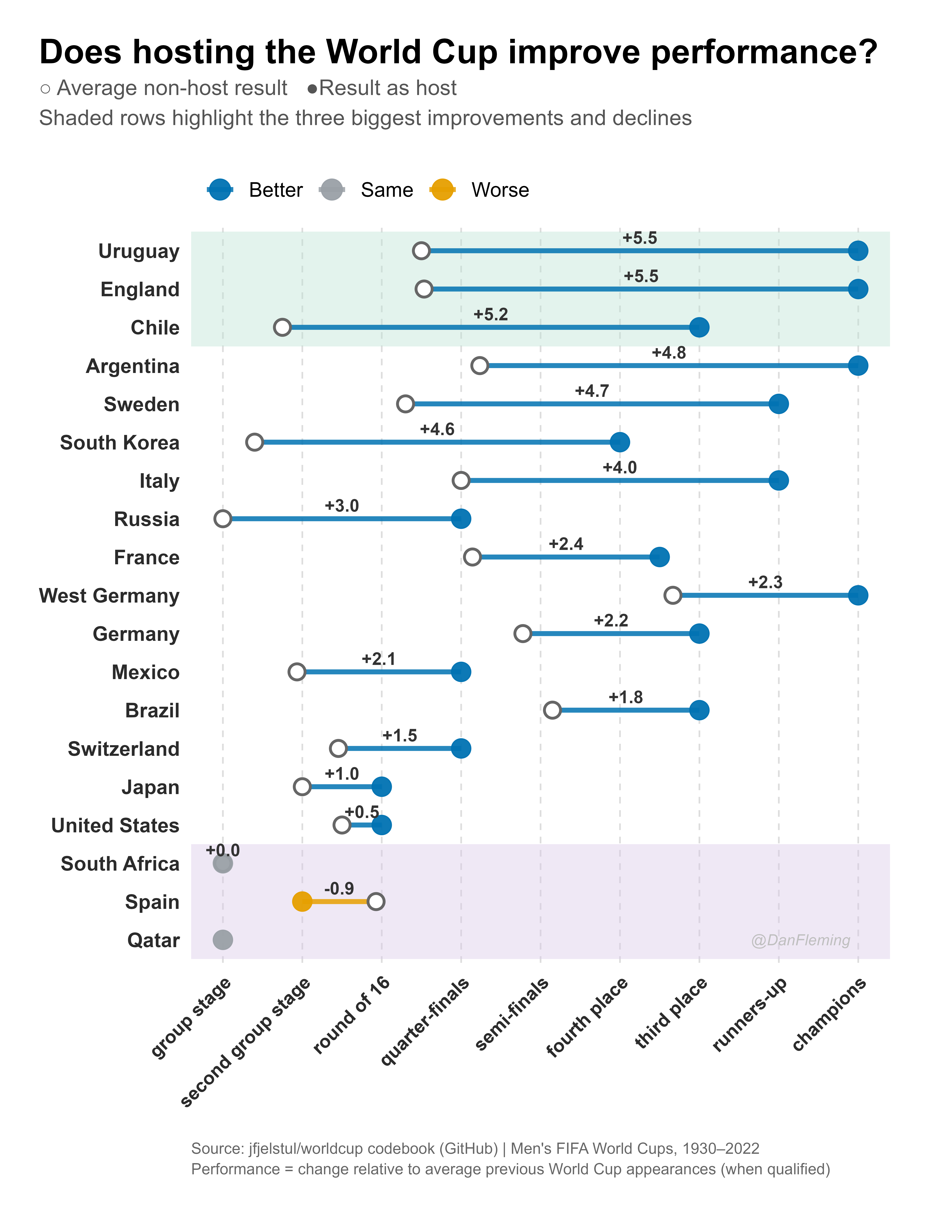
The result: 16 of 19 hosts outperformed their career average, several by a wide margin. Uruguay (1930) and England (1966) both jumped the equivalent of 5.5 tournament stages compared to their historical norm - of course, both went on to win their respective tournaments. Chile (1962) and Argentina (1978) weren’t far behind in improvement either.
Only one host got worse relative to their average, Spain in 1982. South Africa (2010) and Qatar (2022) were the only two who landed exactly on their typical level - likely due to typical group stage exits in the case of South Africa, while Qatar’s time as host was their first qualification.
However, most countries have only hosted the World Cup once, so we’re working with a very small sample which means a single data point (one great or terrible tournament) carries a lot of statistical weight. I wouldn’t run a regression on this and call it proof, but with 16 of 19 cases pointing in the same direction, it’s a pattern worth considering. With this in mind, I’m keen to see how this year’s three host nations continue to progress through the tournament. Will the home advantage continue to play out in this way, with teams over performing? My money’s on yes - but I’d love to hear your theory: crowd support, lack of travel, or federations simply building stronger squads around a home tournament?
This is the first post on The Numbers Game, if you’re into this kind of historical sports data digging, I’ll be doing one of these most weeks. If that sounds like your thing, subscribe below and you’ll get the next one straight to your inbox. While the World Cup is ongoing, I’ll be focussing on that, but will open up to other sports such as basketball and baseball as those seasons continue and pick back up! Feel free to reply with ideas or questions you’d like me to try answering, or other sports/datasets you’d like me to take a look at!
I think also particularly in the early years of hosting that there were off-pitch factors that led to host nations' performances. Whether it be Mussolini's handpicking of refs for the 1934 World Cup, Argentina's antics in their home tournament in 78 or even England sending Portugal to Merseyside for a World Cup Semi Final (Vs England) in Wembley. A lot of the early modern world cups are marred by controversy and scandal.
Solid post! The trend is already set to continue for at least 1/3 hosts as Canada didn’t even manage a point in Qatar last time around and are through to the knockout stage this time!