
Fernandes, Semenyo, Bowen: The FPL Luck Index
Before you spend £12m on a striker who scored 22 goals last season, it's worth asking if past results predict future performance.

I love fantasy sports. My friends at work laugh at me and wonder when I have any time to do my real job. In a typical year I’ll play Fantasy Premier League (FPL), Fantasy Football (NFL), Basketball (NBA), Baseball (MLB), Tour de France (TDF), and on occasion, Fantasy Diamond League for the athletics season. Oh, and the annual sprinkle of a March Madness bracket.
This year, I decided to go particularly deep into FPL and ended up winning my work league and finishing in a respectable 558,626th (top 4.3% of managers) - not too bad out of over 13 million managers in just my second season.

It goes without saying, I still had some very rough weeks. Raging on a Monday night when a player I sat on my bench drops 13 points. Or refreshing my FPL app to check if that player with a rumoured injury is going to start while I’m out with friends. Now we’re only a month or so away from the new season starting, and with the new game just launched, I thought I’d use this as an opportunity to apply some data storytelling to the art of FPL, because one of the keys here is to see where luck ends and skill begins.
So, who got lucky last year? Who was unlucky? Are they likely to do similar this year?
To answer these questions, we can use xG and xA to see who performed better (or worse) than we might expect them to. Before that, we need to establish what these things mean. Expected Goals (xG) measures the probability that a shot will result in a goal. Expected Assists (xA) measures the quality of the scoring chance a pass creates, basically, the xG of the shot that followed. They take into account things like player position, actions leading to the shot, and patterns of play. Each individual chance is scored from 0 and 1, where 1 would equal a goal 100% of the time. These can be added together across a season to give the total amount of expected goals.
We can use these statistics to see how players perform based on what we’d expect them to accomplish. The first figure below, shows how forwards and midfielders (with at least 5 xG and 900 minutes in the 25/26 season) scored relative to their xG.
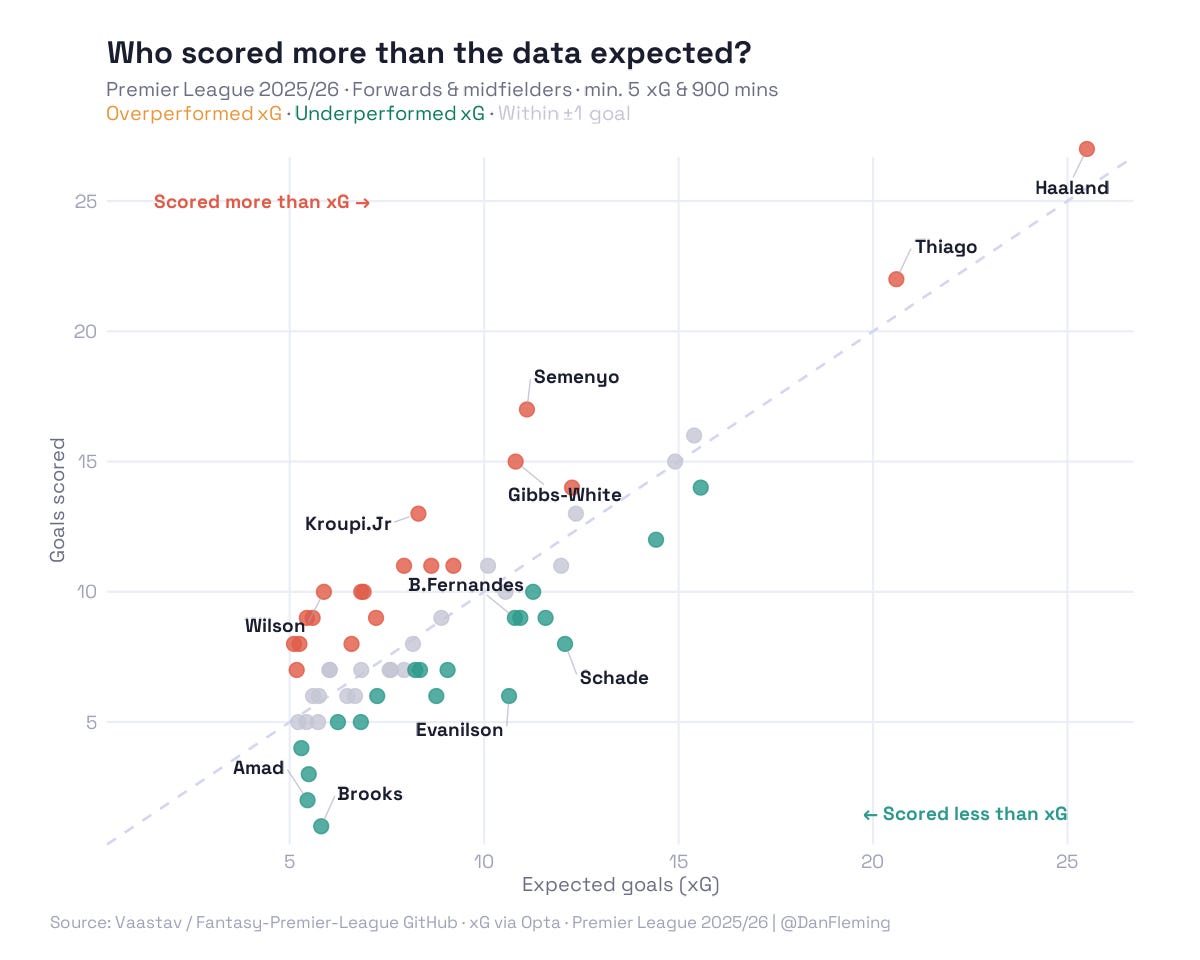
In the top right corner, we see Haaland. His expected goals was just over 25, and he scored 27, so he just outperformed what we’d expect him to do. Thiago was a similar story, slightly outperforming his xG with actual goals. Those that rise above the line scored more goals in the 25/26 season than we’d expect them to. Those below the line underperformed. The over performers worked well with the lower quality chances they were afforded. This isn’t too much of a problem with Haaland or Thiago, who only slightly outperformed their xG, but for a player like Semenyo, who scored significantly more than we’d have expected him to, we might need to consider a regression to the mean this season.
On the other side of that line are the players that underperformed. The question here is if they were unlucky and faced some exceptional defending/goalkeeping, or were just out of sorts when it came to finishing. These players could be undervalued FPL assets this year, about to bounce back after some poor variance - but they could also be on a downtrend and might need to be avoided. This is where you need to have some sort of strategy ahead of time to avoid sinking weeks and weeks into an underperforming asset that you’d be best to pivot away from earlier.
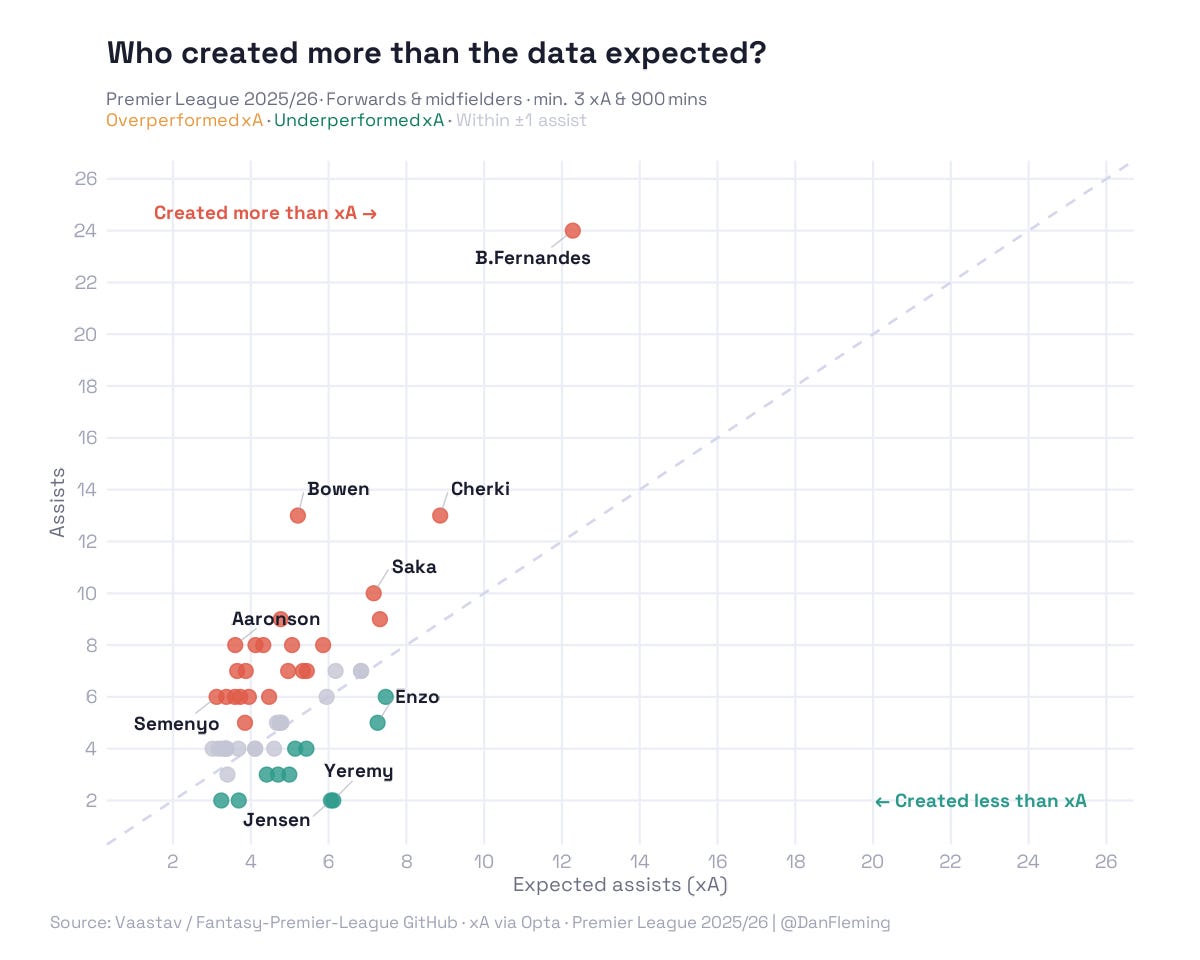
Assists are another key point scorer in FPL (3pts), only one less than a goal scored by a forward. To optimise our point potential, we should be trying to identify players with high assist threat to complement our goals. The standout, and huge outlier, here is Bruno Fernandes. He massively overperformed his xA with his actual assists, along with (but to a lesser extent) Bowen, Saka, and Cherki. This positions him as a solid option for a set-and-forget style player, who will produce and outperform many others. This is true even if he doesn’t perform quite as well as last year. You can see below that he not only had the highest number of assists, but also the highest xA - so if he does get a little unlucky this season, his xA numbers are still good enough for us to expect a pretty good return on assists (just probably not as many as last year).
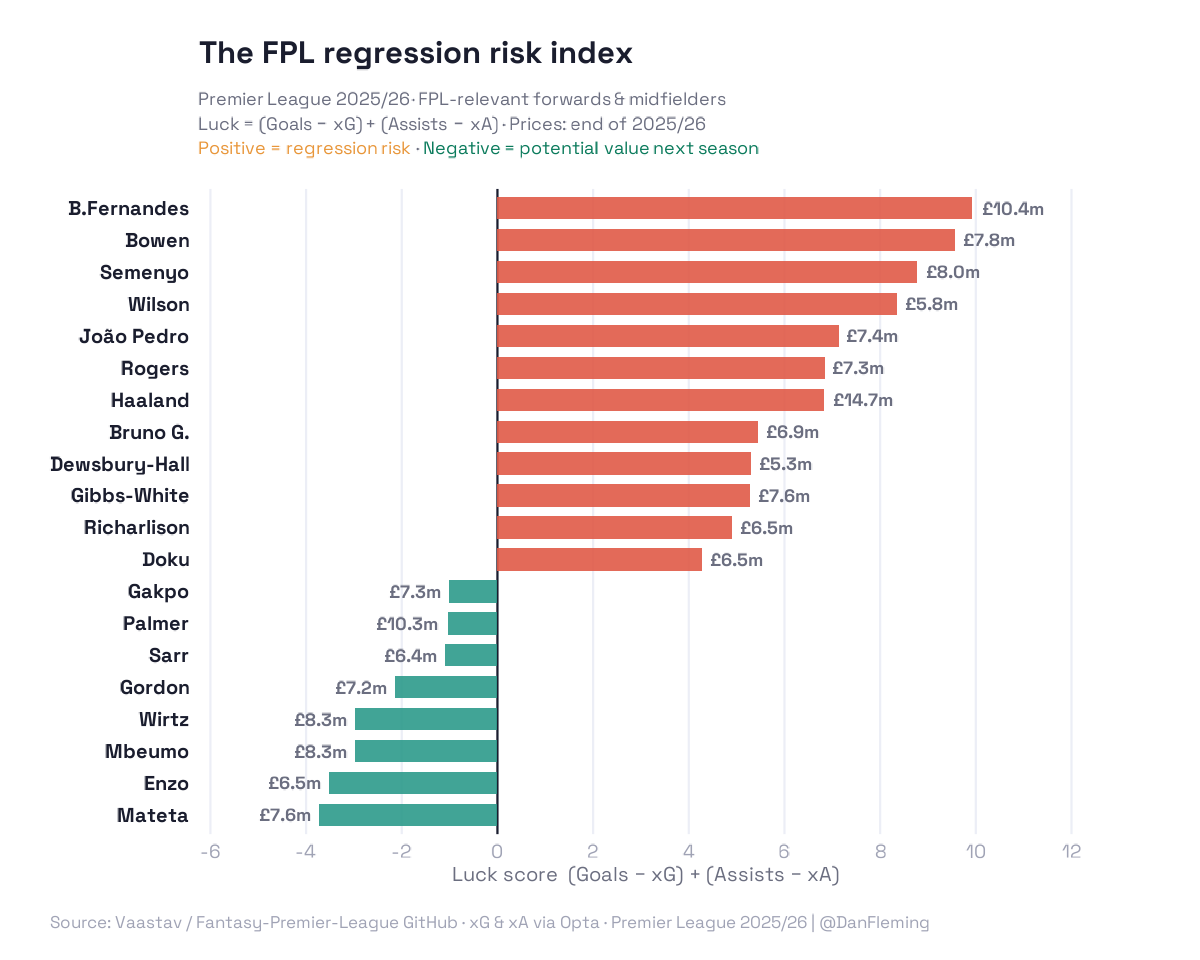
With FPL being a game about probability and expected value, I created a regression risk index by calculating a ‘luck score’. This figure captures how much a player outperformed their xG + xA (of course this isn’t always purely luck, but they’ve been on the side of favour in some way). Those with a positive score (coral) indicate players who dramatically over performed last season and present as the biggest risk for regression and a step back this year. Those in teal are players who underperformed, and therefore could provide sneaky value in 25/26.
Players in the positive might still perform well, but I’d be wary of expecting them to produce at the same level as last year (i.e. Fernandes, Bowen, and Semenyo). So select (and triple captain) at your own risk!
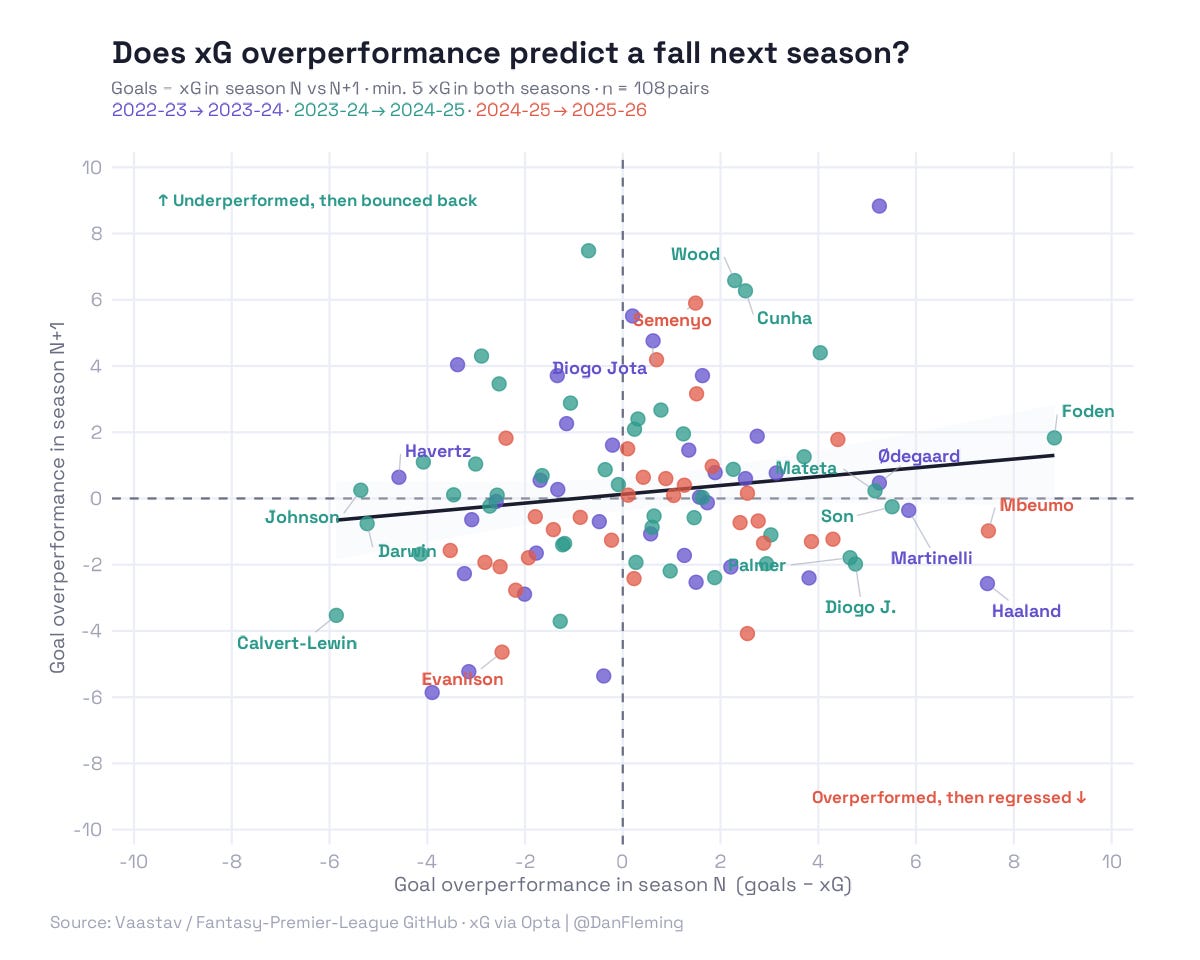
The final thing we need to understand before we make any big decisions on what to expect this year is if history tells us to expect this regression and fall from the over/under performers.
The figure below shows the last 3 pairs of seasons (23/24, 24/25, and 25/26) and plots player’s goal over performance in one year against their performance the next year.
You’ll see that the line is fairly flat, but does tick slightly upwards. This would indicate that just because a player had a standout over performance season one year, doesn’t mean that we can expect that they’ll go either way (up or down) in the season that follows. If anything, the slight uptrend suggests that elite players have a slight tendency to repeat their over-performance, which is exactly what you’d expect from players who are simply better than the model assumes, but this isn’t a steep line by any stretch. So one of our ‘lucky’ players last season might not regress, but we also might not want to expect them to continue over performing to the same degree year after year.
So, don’t avoid a player just because they performed well. After all - the elite are the elite for a reason. BUT, remember the volatility, don’t blindly expect past performance to predict future performance, and be critical when a player is vastly outperforming their xG and xA consistently. The goal for me this year is to identify players that fall into one of these categories.
First, the under-performers from 24/25 - these will likely be cheaper assets this season who could bounce back towards what we’d expect from them. They could also be some nice differential picks. Second, Haaland and Thiago. Yes, Haaland sits in the regression risk column, but he outperforms the rest of the league so clearly in both xG and goals, that even if he does regress, he still provides more value than most other players. Third, players who had some fortune last season but still created enough underlying quality that a return to their expected output still makes them strong scorers - Fernandes and Cherki being the obvious examples.
I know I’ve made FPL seem straightforward here, it’s not. It’s a game of probability and making the best decision available with the information you have at the time. Your job as a manager is to put your team in the best position to score lots of points, you can’t get wrapped up in the week by week variance and luck. Don’t keep a player in your team because you’ve had them in for a while and it is their turn to pay off. That screams sunk costs fallacy - where we’re reluctant to pivot because we’ve invested so much already. Sometimes the best move is to cut your losses and move on.
It will take some luck to win and perform well, but consistency over 38 game weeks is the most important thing.
If you’re playing FPL this year and enjoyed the article, join The Numbers Game mini-league here and get active in the chat!

May your green arrows be plentiful, and bench points remain minimal 🫡.
Who will you be choosing in your starting 11 this year? Any nailed-on-picks? Any crazy differentials? I’m keen to hear in the comments!
Love this Dan. Can I ask how you create your graphs? Or were these pulled from another source? Great work all the same!
Is Mateta as interesting option as I think he is? Every time I watched him play he made an impact last season.