
Do World Cup Hosts Actually Trust Their Veterans?
I crunched 90 years of squad selection data to see if host nations build around squad stability, or favor a complete personnel overhaul.

Last week, I took a look at how host countries usually perform at the World Cup. I was surprised by how clear the pattern was: 16 of the 19 World Cup hosts improved their performance compared to their historical average (catch up here if you missed it). This got me thinking, why might that be the case?
Of course, it could be pure chance - things often are - but it could also reflect a whole host of other factors. Home support springs to mind as one explanation, perhaps it is due to the hosts naturally having less travel to do right before the tournament, or maybe national federations are particularly strategic in the years leading into a home tournament. This final idea caught my interest. After reading Das Reboot a few years ago, I was fascinated by the DFB’s approach to player development in the early 2000s and 2010s. Similarly, the English FA have been very vocal about their England DNA development plan - which seems to have worked nicely given the recent tournament runs of the Three Lions. So, I decided to see if there was some credit to the idea that host nations typically have years to prepare for the tournament, perhaps they are able to develop and build a core group of players ahead of time.
So thanks to Josh Fjelstul’s brilliant World Cup dataset, I calculated a squad continuity statistic: the percentage of players who overlapped between their nation’s hosting tournament and the one prior. I then compared that figure to the same team's typical squad continuity in non-hosting tournaments, to see whether hosts behave any differently than they normally would. Now, it is important to remember that sample size is relatively small here - even more so than usual because some hosts (like Qatar) don’t have a previous tournament prior to hosting, so take these findings with a pinch of salt. This analysis also spans across eras, so the hardcore developmental approach that most federations adopt these days might look a little different to those who hosted back in the 50s/60s.
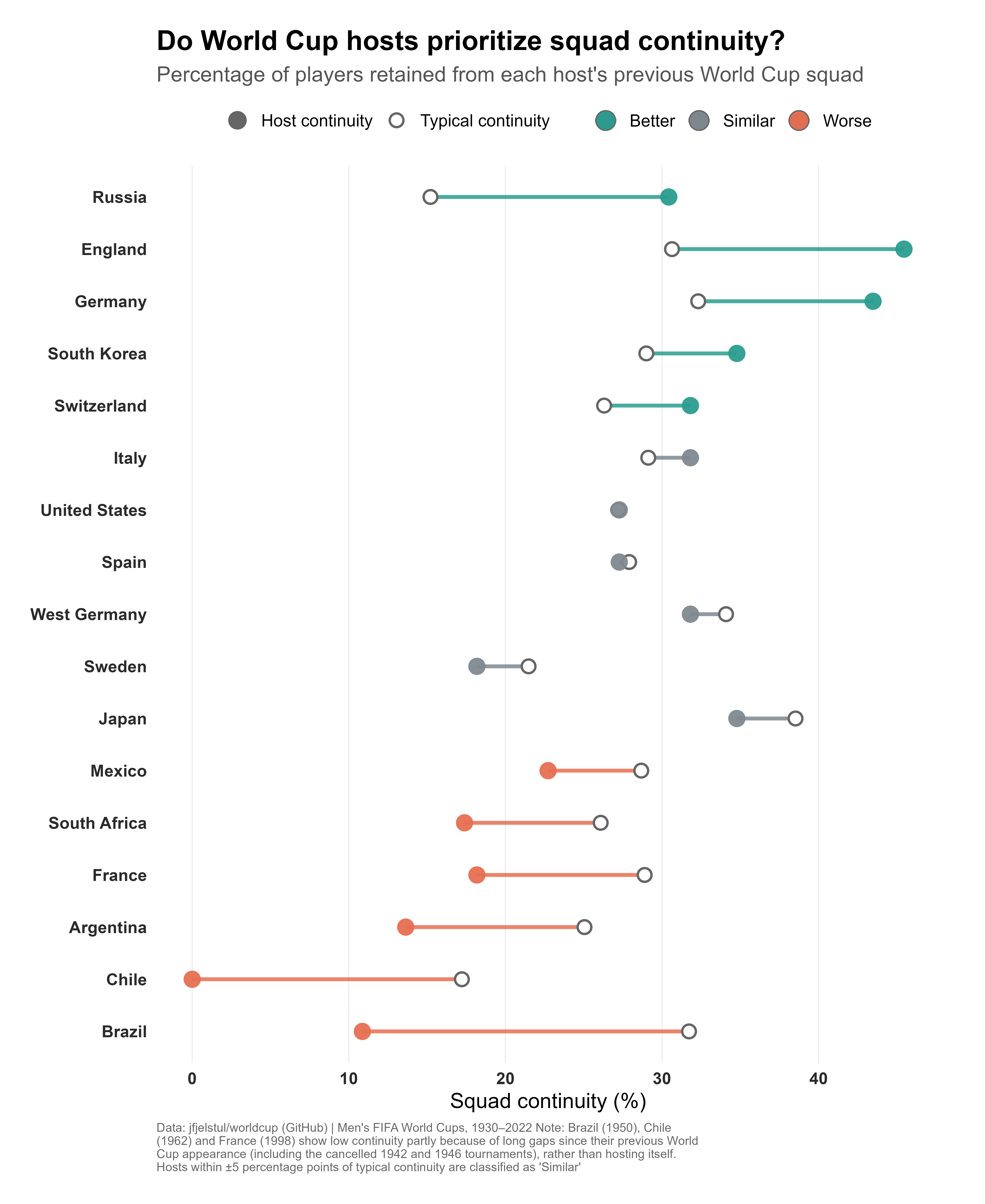
Unlike last week’s data visualization, the picture here doesn’t point in a single direction.
The most striking cases are England and Germany, both of whom show a very large positive gap in the figure. This indicates that they both arrived at their home tournaments (1966 and 2006 respectively) with a notably higher squad continuity than is typical for them - of course, England won and Germany finished third in those years respectively. Russia also followed a similar pattern when they hosted in 2018, outperforming their historical performances. Whether the continuity was the cause or simply a byproduct of systems surrounding these teams is unknown and impossible to say from these data alone, but for anyone who has read Das Reboot, this might be an interesting finding.
Then there comes France ‘98, sitting firmly in the negative. Deschamps lifted the trophy with a squad that had significantly less continuity than Les Bleus typically manage across tournaments - so much for a neat narrative in this one.
On the whole, hosts are roughly spread evenly across the three camps of higher, the same, and less continuity than normal. There’s no version of this figure that screams out ‘federations systematically build stability ahead of a home tournament’ - at least not in a way that shows its head in squad continuity. A few of those toward the bottom of the figure deserve a little asterisk. Brazil, Chile, and France’s lower continuity figures are also partly a product of long gaps since their previous World Cup appearances. These include the cancelled 1942 and 1946 tournaments. I’ve flagged this in the figure note, but it’s worth keeping in mind when reading those lines.
So, where does this leave us? Hosting the World Cup seems to help - that much is pretty clear. However, if the mechanism was as straightforward as ‘build a settled squad’ then we would expect to see a much clearer pattern here. We don’t. That doesn’t mean preparation isn’t important, it simply suggests that squad continuity isn’t where the story lies. Perhaps home support, reduced travel, familiarity with conditions, or broader investment in infrastructure matter more. Or maybe the mechanisms are too subtle for this type of analysis.
We'll find out soon enough whether the USA, Mexico, and Canada continue to outperform their historical performances, but I'm still no closer to knowing why hosts tend to do so.
I’d love to hear your theories.
I’m glad Sophia connected us because I love me a good dumbbell chart! Great analysis and I’m excited to see if our host nations this year keep the pressure up. Looking forward to more!